
Vault #26: Barracks | Private Quarters
A Special Look at the Inscriptions and Stories from Rooms 104 & 204
-
Room 104: History • Inscriptions • Stories
Room 204: History • Inscriptions • Stories
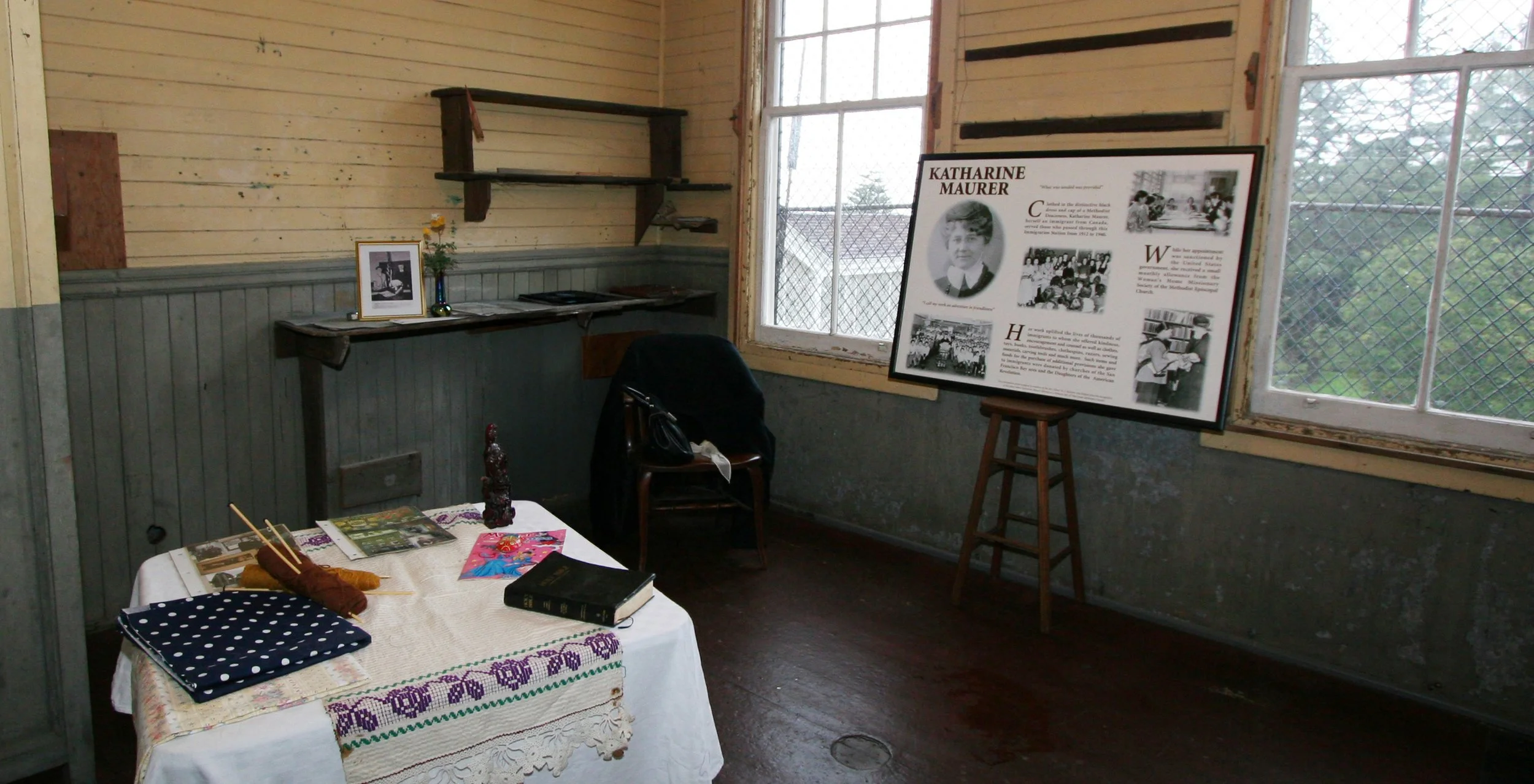
Room 104 holds visible traces of its past. A scar in the floor marks where metal bunk beds once stood during the immigration era. Along the walls, remnants of shelving and structural supports remain from its use as a photography room during World War II. Photo credit: AIISF.
Rooms 104 and 204 were used for special immigrant cases. Those confined in these dormitories may have been accused of breaking the rules, attempting escape, or were considered incompatible with other immigrant groups. Located next to the first- and second-floor guards’ office, the small dormitories offered little privacy, and those inside were kept under close supervision.
The site’s detention records were destroyed in a fire in August 1940, leaving no complete list of who was held inside the barracks. Still, newspaper accounts and physical evidence found within the rooms help us piece together their history. By examining the rooms’ features and wall inscriptions, we begin to gain insight into how it functioned and who may have been detained there.
Today, only room 204 remains open to museum visitors; room 104 is closed to the public and serves as a private office for park employees and volunteers.
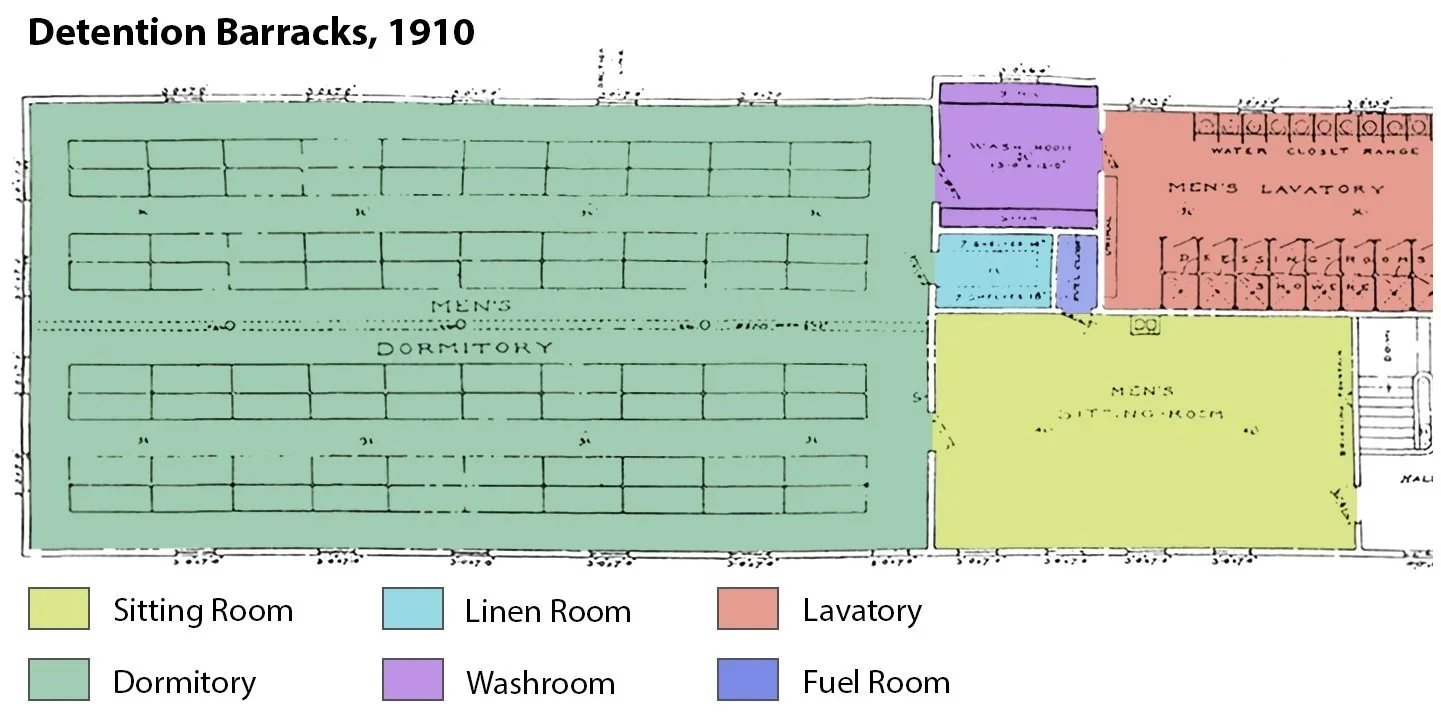
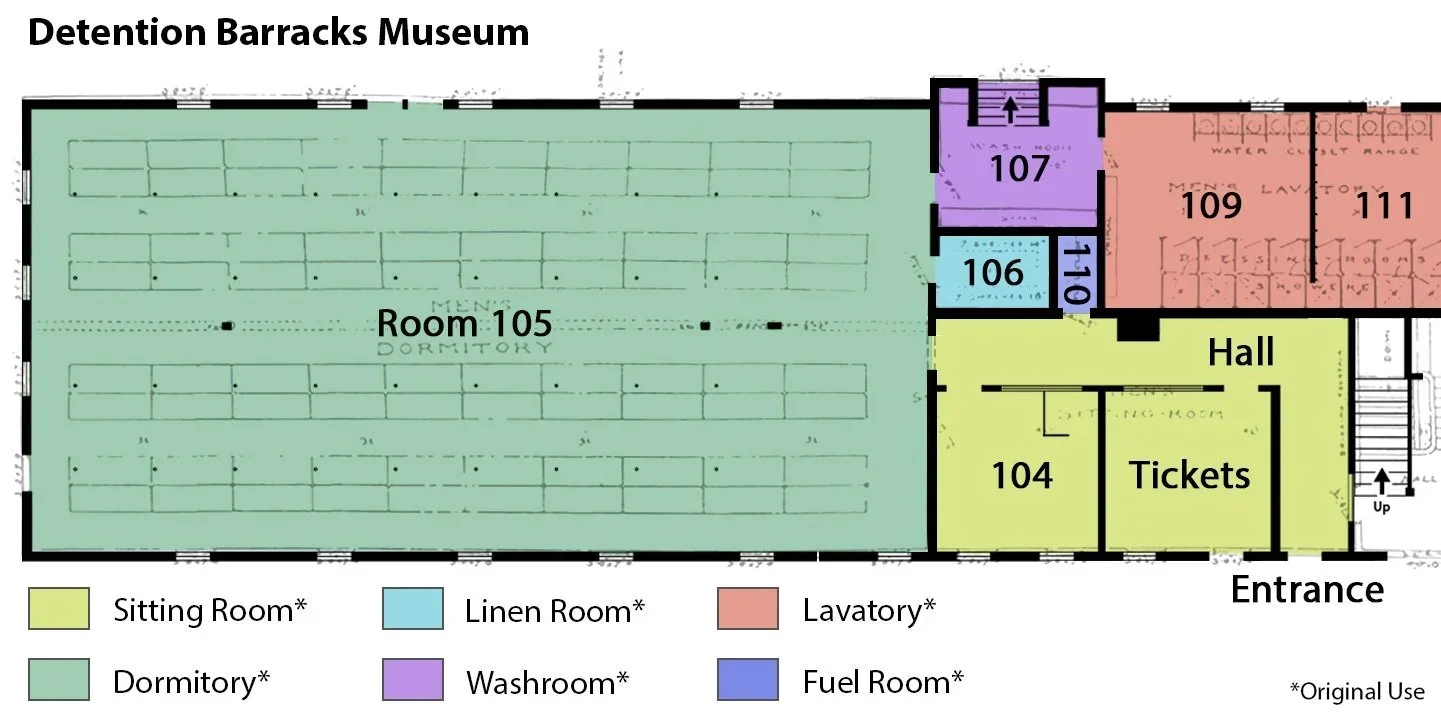
The original configuration of the detention barracks did not include separate spaces for guards and private detention. When the site opened in 1910, the large men’s dormitory had a sitting room for detainees. Eighteen months later, officials added partition walls to create three separate rooms: room 102 (hall), room 103 (guard office), and room 104 (private detention). The upstairs sitting room was also divided into three spaces that functioned similarly to the ones downstairs.
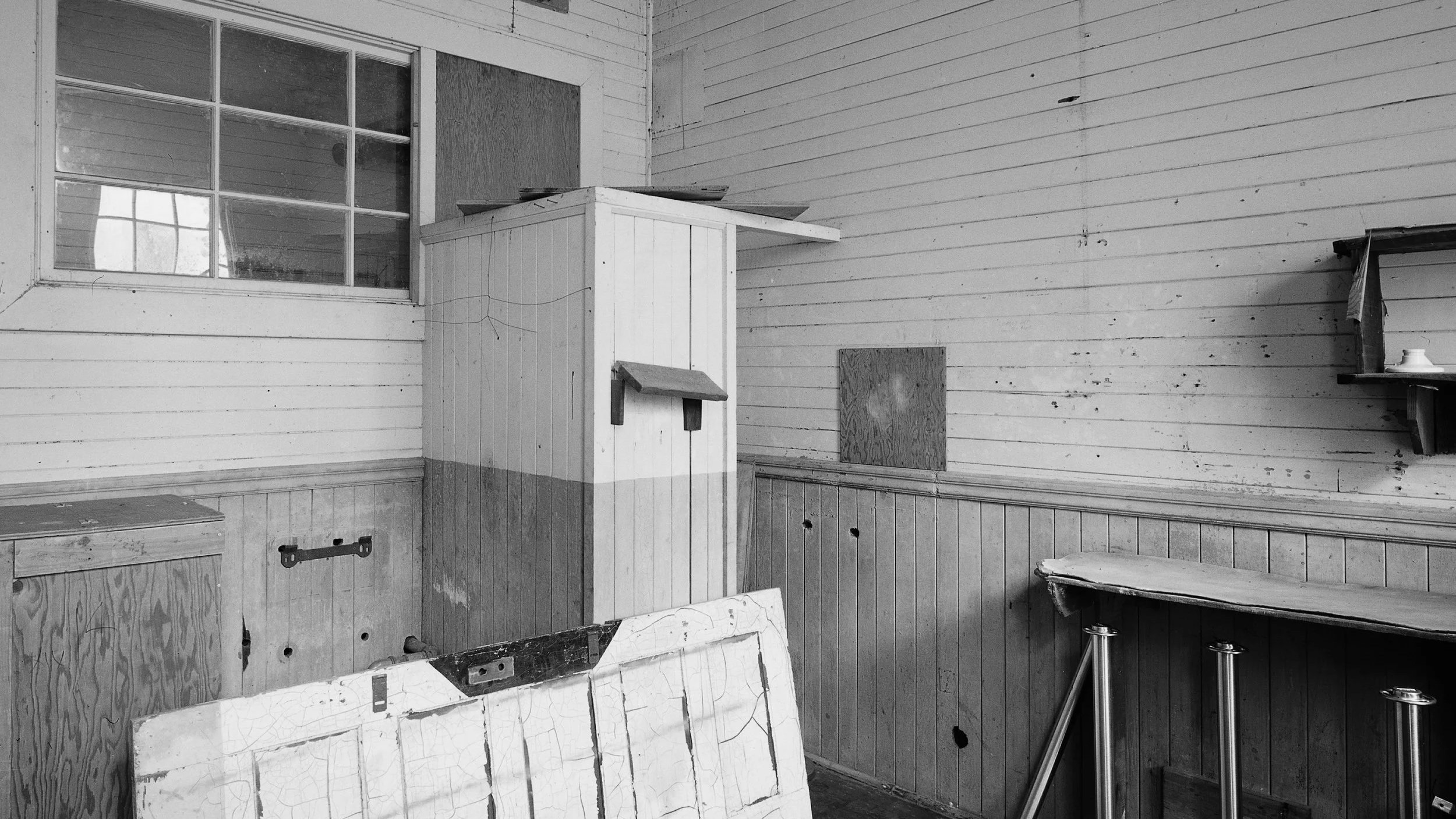
The partitioned toilet in room 104 offered some privacy for detainees. The large window above it allowed daylight to reach the barracks’ interior hallway. Photo credit: Architectural Resources Group, 2000.
-
1910 - 1911 | Japanese Men’s Sitting Room
1911 - 1940 | Special Confinement
1942 - 1945 | Photography Room for POWsWhen the detention barracks opened in 1910, the first floor housed Japanese immigrants. The east side of the building, where visitors enter today, was designated for Japanese men. At the time, room 104 did not exist as a separate space. It was part of a larger sitting room where immigrants could read, play games, and socialize. Because there was no outdoor recreation in 1910, men spent most of their day indoors. However, this all changed in June 1911, when immigration officials altered the floor plan and gave detainees access to a small outdoor yard.
The building alterations also divided the sitting room into three separate spaces: a hallway and two smaller enclosed rooms. One of these rooms became room 104. Records show it was a small-occupancy dormitory for what officials described as “special cases.” This included men placed under closer supervision and individuals separated from the general population due to race, class, or status, such as prisoners or merchant seamen.
During World War II, the room functioned as a photo lab for prisoners of war. An Army Service Forces memorandum from 1944 described the intake procedure for POWs, which included a stop at the photo lab. First, arriving prisoners were disinfected, searched, and counted before entering the barracks. Then, they were sent to a processing room where their internment numbers were assigned. Afterward, they were fingerprinted and photographed in the photo lab.
Room 104: Inscriptions
Like other dormitories, the walls of room 104 are marked with names, images, and other inscriptions. Two former occupants, Mario Rossetti and Felipe Lerena, have been identified by matching their names to public records. Several first names and initials appear, including Ryan, KC, LA, Mike, and Sal, but there isn’t enough information to confirm their identities. Other inscriptions are written in Japanese. These include 日般 (sun like) and 大和民族 (People of Yamato). There are also English carvings referencing locations in Japan: Wakayama-ken Man and Kobe.
When the immigration station closed in 1940, the barracks was used by the US Army. Inside room 104, soldiers added shelves along the west wall and fitted frames around the windows to block out light. Soldiers also left pencil markings in various places.
Outside room 104, the words Photography Room appear in black letters on the door as well as two other room identifiers: RM E and 22 (102-N-2).
One inscription from the WWII era appears to offer technical instructions to the photographer: “Big Camera, Best Results at F-8 1/50” (104-W-1).
An illustration of a uniformed fisherman appears near the door of the room (104-E-2). Resident employees were known to fish from the immigration station’s wharf, including the site’s laundryman Philip Garcia, who kept his catches on ice in his bathtub.
A native of Bilbao, Spain, Felipe Mauricio Lerena was a merchant seaman who snuck aboard the SS Noorderdijk in 1922. The twenty-year-old stowaway was briefly held on Angel Island before being deported on March 23 (104-E-2).
On one area of the wall is a small image of the National Flag of Japan waving in front of an anchor (104-E-2). To the right of this image is another flag and anchor carving that appears to be an earlier draft of the one seen here.
Room 104: Stories
Two carvings made by Mario Rossetti in room 104. Top: “Mario Ross” (104-S-1), the surname appears unfinished. Bottom: “Mario Rossetti” (104-E-2), the carving shows his full name clearly inscribed.
In 1929, Mario Rossetti, an Italian man, was sent to the immigration station because the nation’s quota limits prevented him from landing in San Francisco. Sometime during his detention, Mario escaped from Angel Island by swimming over one mile to Tiburon. He inscribed his name twice in room 104. The inscriptions were likely made after his capture and return to the immigration station.
Mario’s story appeared in the Oakland Tribune on February 24, 1930.
-
Woman Scorned Tells Officers Where to Find Violator of Immigration Law.
SAN FRANCISCO, Feb. 24—Because he spurned the love of a woman, Mario Rossetti, 22, who gained entrance to the United States last September by swimming nearly a mile from an Angel Island deportation camp to Tiburon, is in custody again today.
Given the address of his hiding place by a young woman who said she once had been his sweetheart, police found the fugitive crouching in a closet in a hotel at 188 Sixth Street. Paul Paulett, tenant in the room in which Rossetti had taken refuge, was arrested on a charge of concealing an immigration law violator.
FLED FROM ISLAND
Rossetti was one of several score Italians who arrived in San Francisco last year after the immigration quota from Italy had been filled. He was being held at Angel Island for deportation when he packed his clothes in a punching bag, strapped the bag around his shoulders, and swam through the cold, swift currents of Tiburon strait to the mainland.
He made his way to San Francisco and found refuge with compatriots in the city. Shortly thereafter he met the girl who later betrayed his whereabouts. He told immigration officials this morning that she pursued him so relentlessly that he was forced to go into hiding to escape her. But she proved to be a more able detective than the officials who had been searching for Rossetti since he made his escape.
FINDS HIDING PLACE
A week after his disappearance, she had traced him to Paulett's room. She notified the police and told them Rossetti was wanted by immigration authorities. Detective Sergeants Louis de Mattei and Frank Brown called the hotel yesterday. They talked with Paulett on the telephone. He denied that Rossetti was in his lodgings. But the detectives went to see for themselves. They crashed through the locked door of Paulett's quarters and discovered Rossetti in the closet.
Paulett, pleading to be released from custody, said he thought it was the clerk calling him on the telephone to inform him there would be an extra charge because Rossetti was sharing the room with him.
The name “Ryan” was carved in room 104 (104-S-1). It remains unclear if Ryan was a first name or a surname. Above it, another carving reads “Wakayama-ken man.”
James Ryan arrived at Angel Island in November 1915 after serving a three-year prison sentence in Leavenworth, Kansas. Although he claimed to be a US citizen, Ryan was misclassified by authorities as a British subject from Bombay (Mumbai) and deported to Calcutta (Kolkata). Once his ship reached its destination, he was stopped by British officials, who sent him back to San Francisco. Upon his return, Ryan told the Riverside Daily Press:
“When I reached San Francisco, I told my story to Officer Frank Haynes at Angel Island, but he refused to investigate. I was deported on January 6 [1916]. At Hong Kong, they threw me in prison. I appealed to the American consul, but to no purpose. Finally, I reached Calcutta. The English officials refused to receive me and here I am again, a man without a country.”
Held once again on Angel Island, Ryan found a niche within the barracks—tattooing. The China Press reported on his story on April 8, 1916.
-
Ryan Not Worrying Over Detention As Long As His Thriving Business Continues.
SAN FRANCISCO, March 1—Prosperity has sprung from adversity in the checkered life of James Ryan, the man without a country.
Ryan is being held at Angel Island immigration station while Washington officials wrestle with the intricate question of his nationality. But Ryan, not unaccustomed to durance vile, has made the most of his detention to build up a thriving business among his fellows in misfortune.
At the island there are a great many Chinese held for investigation or deportation. Among the arts Ryan has learned in his world travels is that of tattooing the human body. He gave a demonstration on the person of one Chinese. There was much jabbered investigation of his handiwork, and the verdict was one of approval. Since that day Ryan has been a busy man. He has tattooed nearly 200 Chinese, some of them quite extensively, and all of them more or less lucratively. As for Ryan himself, he is sufficiently tattooed to be worth a job as a dime museum exhibit. No South Sea islander was ever more gloriously illustrated.
The dispute that is keeping him at Angel Island is whether he is American or British. Ryan was deported on his representations that he was British. In Hong Kong he asserted he was an American, and was re-deported. Now he says he is an American and wants to stay in this country.
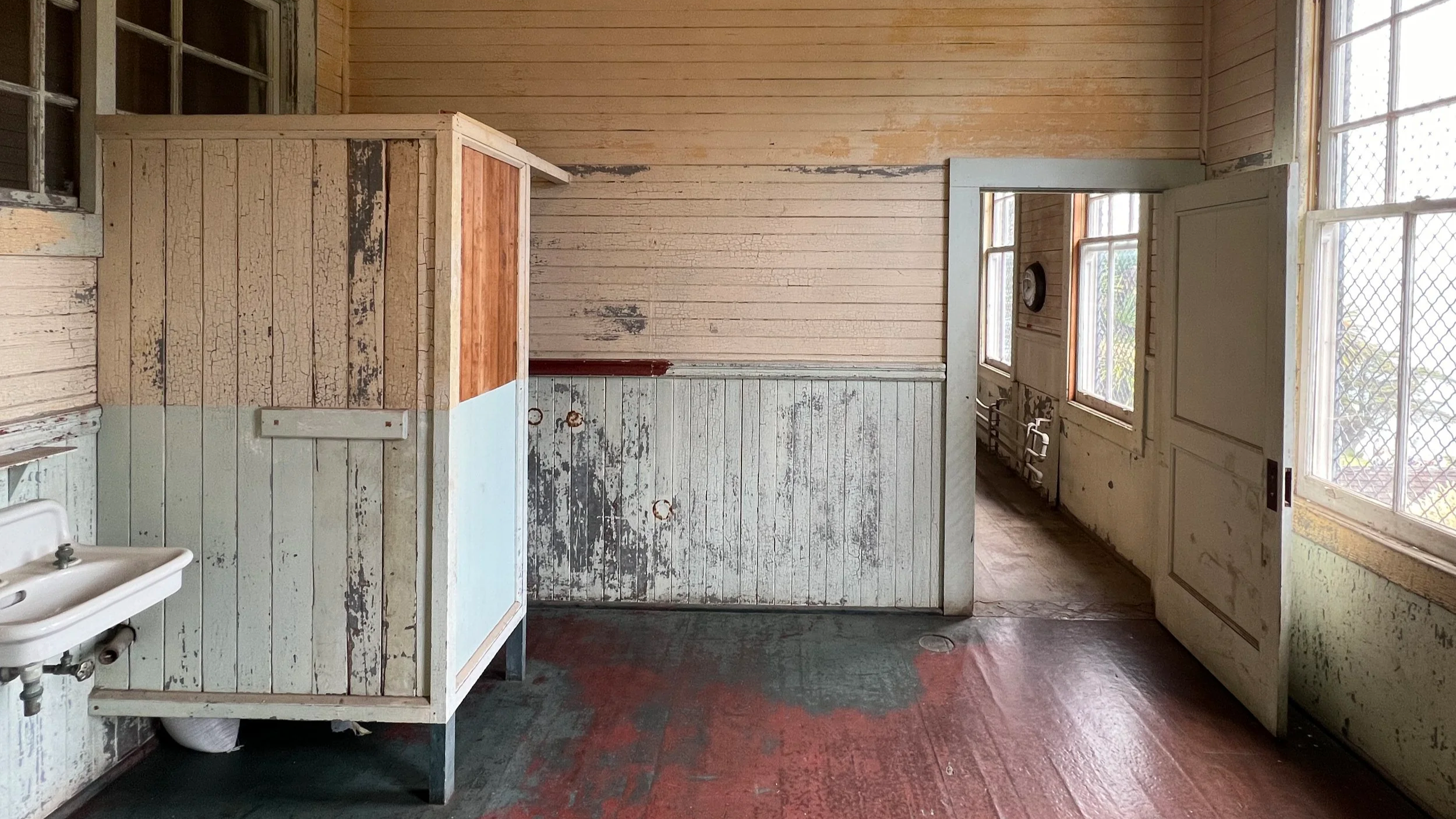
Room 204 features a distinct color scheme compared to other rooms in the barracks, a result of its use as a military infirmary during World War II. By the 1940s, the US Army had transitioned away from bright white interiors, which caused eye fatigue for surgeons, in favor of light green and cream. Additionally, the room’s chair railing is painted maroon, a color historically associated with the US Army Medical Department. Photo credit; AIISF.
-
1910 - 1911 | Chinese Men’s Sitting Room
1911 - 1940 | Special Confinement
1942 - 1945 | POW InfirmaryIn 1910, the second floor of the barracks housed Chinese immigrants. As on the first floor, the east side of the building was used to detain men.
When the east wing sitting rooms were divided in 1911, the second floor gained another small-occupancy dormitory for “special cases.” While room 204 eventually featured three entrances, the dormitory beneath it (room 104) had only one. These additional entrances were likely installed during World War II.
Evidence for this timing comes from detainees Tet Yee and Smiley Jann. Both men documented Chinese poems in the 1930s that were later destroyed when a door was cut between room 204 and the Chinese men’s dormitory. Because Yee and Jann recorded at least two of these missing poems—Island 23 and Island 98—scholars have been able to locate them from remnant characters on the wall. The fact that these poems existed during Yee’s and Jann’s stay indicates the door did not appear until sometime after 1932.
During World War II, the room functioned as an infirmary for prisoners of war. A 1944 POW Base Camp Visit Report identified an infirmary on the second floor responsible for dispensing emergency care. Because many POWs arrived with injuries from the war, the doctor averaged approximately 20 sick calls daily.
Room 204: Inscriptions
Only a handful of inscriptions have been identified in room 204. In contrast to room 104, which contains evidence of deportation cases, this room largely features individuals connected to islands in the South Pacific. The one exception is an inscription from World War II, possibly left by a US Army servicemember or a German prisoner of war.
The most deeply-carved inscription in room 204 can be found on the north wall. It says “Vive la France,” which translates to “Long Live France!” (204-N-1). This unsigned carving may have been made someone from France or possibly French Polynesia.
A pencil inscription on one of the doorways to room 204. Names appearing on the walls in pen or pencil typically date to the WWII era, unless it’s more modern graffiti. This partially-legible marking reads: “Fred E. Nault(?) left here March 20, 1943” (204-E-1).
Located near another inscription from Tahiti is a carving that has been mostly obscured by layers of paint. It appears to say “Mattua Richmond(?) / Tahiti” (204-W-1), however, there is currently no evidence of someone by that name being detained on Angel Island.
Room 204: Stories
Left: “Taie / Tahiti” (204-W-1). Right: “Taie / Tahiti 1924” (204-E-2). These two carvings were made by Taie Taihotaata. They can be found on the east and west walls of room 204.
Taie Teihotaata, a 19-year-old resident of Papeete, Tahiti, arrived in 1924 to attend school. The American consul told him that students could enter the US without problems. Instead, he and others from his ship were detained under policies created by the Immigration Act of 1924. Taie carved his name on the walls of room 204 twice.
One easy-to-miss inscription in room 204 belonged to John Douglas “J.D.” Burgess. It is a four line carving that says, “Xmas - 32!! / J.D. Burgess / Wellington, N.Z. / Also in 1923-5” (204-N-2).
John Douglas Burgess was a sailor from New Zealand who was detained in this room during a visit to San Francisco. He regularly passed through the port as a crew member on steamships. JD’s family later recalled that he jumped ship several times to remain in the US. He claimed that a judge allowed him to stay after his last attempt.
People of the South Pacific
Travelers from the South Pacific, like Taie Teihotaata and JD Burgess, were routinely detained on Angel Island. Although we don’t have an exact count of how many men from Tahiti and New Zealand were held at the immigration station, several left their marks inside the barracks.
Room 207—“Tahiti / 8-24-33” and “W. Keenan / Auck. N.Z” (207-N-3). In a former upstairs lavatory, two inscriptions reference Polynesia. The author of the Auckland inscription, William Francis Keenan, was a merchant seaman who worked for the Union Steam Ship Company of New Zealand. The author of the Tahiti inscription is not currently known.
Room 210—Upstairs, one historic inscription was removed from the barracks. The text read, “Vivian Vincent / Tamarii Tahiti” (210-S-1). Vivian was a 29-year-old oiler on the schooner Beulah when it arrived in San Francisco in April 1927. Beneath Vivian’s name, he inscribed “Tamarii Tahiti,” a Tahitian phrase meaning, “Children of Tahiti.”
Room 211—Top: “Teao Huri” (211-N-6). Bottom: “Huri / 1918” (211-E-1). Teao Huri was a merchant seaman who made four trips to San Francisco between 1917 and 1926. His name appears on two neighboring walls in the international men’s dormitory. The dated inscription suggests he was detained during one of his two trips aboard the SS Moana.
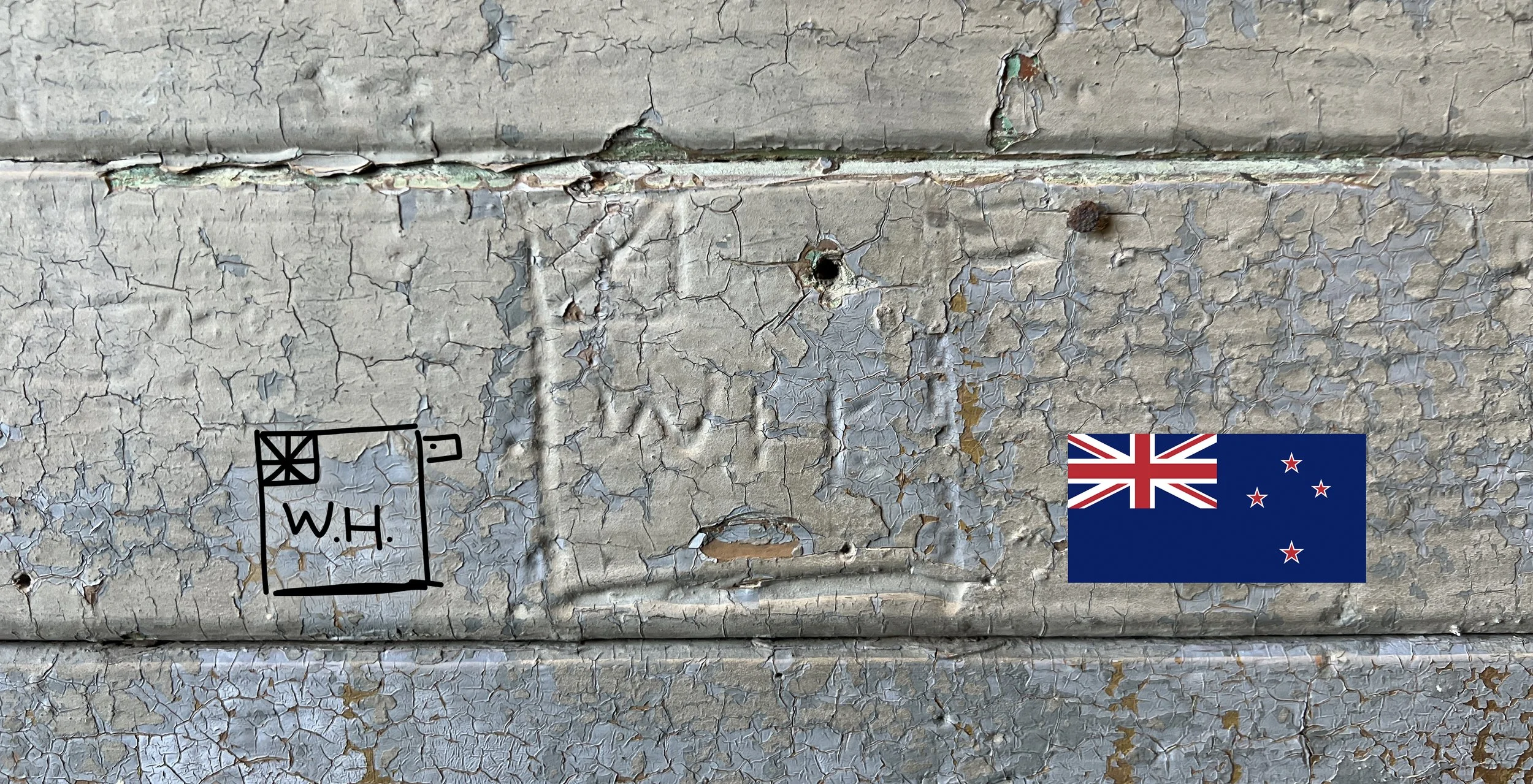

Room 115—In one of the downstairs dormitories, a carving resembles New Zealand’s national flag with the initials “W.H.” inscribed inside the design (115-E-1).
Locating the Inscriptions
Many of the historic inscriptions referenced in this post are still visible today. Markings with an asterisk (*) are behind locked doors and out of public view. Correspondingly, the numbered inscriptions can be found throughout the various rooms of the barracks.
1. Vive la France, 2. Fred E. Nault, 3. Mattua Richmond 4. Taie Teihotaata, 5. Taie Teihotaata, 6. J.D. Burgess, 7. William Francis Keenan, 8. Teao Huri, 9. Teao Huri, 10. New Zealand flag, * Inaccessible
Special Acknowledgment
AIISF would like to acknowledge the work of Dr. Charles Egan, whose decades of research and translations have given the public a greater insight into the experiences of former Angel Island immigrants. Several of the inscriptions featured in this post appear in his book Voices of Angel Island: Inscriptions and Immigrant Poetry, 1910-1945. These include entries regarding Felipe Lerena, John Douglas Burgess, William Francis Keenan, Vivian Vincent, and Teao Huri.
Architectural Resources Group. “Angel Island Immigration Station Detention Barracks Historic Structure Report,” October 2002.
Askin, Dorene. “Historical Report for the Angel Island Immigration Station,” June 1977.
Davidson, Mark and Quan, Daniel and Moore, Darci. Interview with the Garcia Family: Philip Garcia Jr. and Bernice Garcia, 2001.
Egan, Charles. "Voices of Angel Island: Inscriptions and Immigrant Poetry, 1910-1945." New York: Bloomsbury Academic, 2021.
Ensign, Josephine. "The Color of Hospitals," josphineensign.com, published May 25, 2015.
Lai, H. Mark, Genny Lim, and Judy Yung, eds. "Island: Poetry and History of Chinese Immigrants on Angel Island, 1910-1940." Second edition. Seattle: University of Washington Press, 2014.
Lum, Linda. "Life in America (Nov. 11 1901-Jan. 4, 1990)," AIISF's Immigrant Voices, 2026.
NARA. "Report of Visit to POW Base Camp, Angel Island, California on 2, May 1944," Headquarters Army Service Forces, May 18, 1944.
NARA. "Standard Operating Procedures," Army Service Forces, HQ Service Command Unit 1936, POW Processing Station, September 29, 1944.
Oakland Tribune. "Alien Fugitive Betrayed to Police By Girl," February 24, 1930.
Samoanische Zeitung. "Deportation Hangs Over S.F. Visitors," October 3, 1924.
Storrs, Marie. Interview with James Poy Wong, 1987.
Riverside Daily Press. "Man Without a Country," January 15, 1916.
The China Press. "Prisoner Prospers Tattooing Chinese," April 8, 1914.
U.S. Army Medical Center of Excellence. "About the Medical Center of Excellence," medcoe.army.mil/about-us.